
Information for conference authors.
Call for Papers

Submission Options
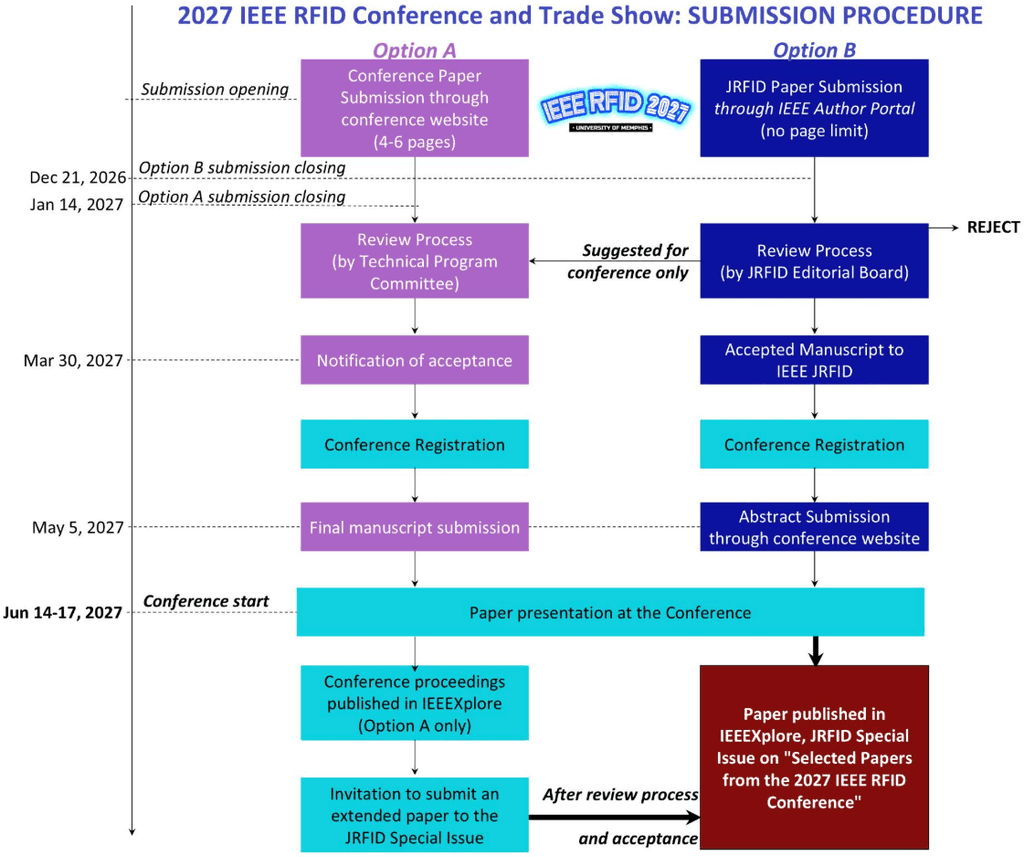
The IEEE Council on RFID is excited to offer a dual-track submission (see diagram below). Authors may choose to submit their manuscripts for peer review through one of two methods:
OPTION A: Submission of a regular paper for the conference
Prepare your manuscript according to the conference-specific instructions and submit through the conference EDAS site. Manuscripts submitted to the conference should be 4 – 6 pages.
The review process will be managed by the conference’s Technical Program Committee and will follow the standard deadlines.
Accepted papers will be included in the final conference program for oral presentations and in the conference proceedings that will be published in the IEEExplore. Authors will receive invitations to publish expanded works in the special issue of the IEEE Journal of RFID (JRFID) “Selected Papers from the 2027 IEEE RFID Conference”. The manuscript must be significantly extended beyond the scope of the conference paper in terms of the overall technical contents and research results (a similarity percentage less than 30% is mandatory).
OPTION B: Submission of a journal paper to the IEEE JRFID
Through the IEEE Journal of RFID special issue “Selected Papers from the 2027 IEEE International Conference on RFID.”
Prepare your manuscript according to the guidelines of the IEEE Journal of RFID and submit it to the special issue “Selected Papers from the 2027 IEEE RFID Conference”. The review process will be managed by the IEEE JRFID Editorial Board. Papers submitted to the conference through IEEE JRFID will not be subject to page limits or charges. If accepted, they will be paginated within the Topic “Selected Papers from the 2027 IEEE RFID Conference” of the IEEE JRFID. They will NOT be included in the IEEE conference proceedings.
After paper acceptance, the authors have to submit the paper abstract through the conference EDAS site (Option B track) HERE. This is important for the paper to be included in the conference’s technical program and for the regular or special session in which the authors wish to participate to be selected.
All IEEE JRFID published papers must be accompanied by a paid conference registration and a conference presentation by one of the authors. Failure to submit will be considered a violation of the “no-show” policy, and the manuscript will not be included in the special issue “Selected Papers from the 2027 IEEE RFID Conference”. However, it will remain published in the IEEE JRFID as an ORIGINAL ARTICLE.
Submission Guidelines
The organizing committee of IEEE RFID 2027 highly encourages authors to submit papers for the conference. Note that the paper preparation depends on the option selected by the authors to submit a paper for the conference. See the call for papers for more information.
Please carefully check the submission guidelines:
Authors of Accepted Papers receive peer reviews by top RFID technology leaders, have their work published on IEEE Xplore (Option A) or in IEEE Journal of RFID (Option B), and are enrolled in the IEEE RFID 2027 Best Paper Competition.
Accepted papers are chosen based on originality, technical content, clarity, and potential impact of results. Submissions must be original and may not be under consideration elsewhere. Cases of multiple publications and plagiarism will be handled according to IEEE policies and procedures.
Formatting
Option A: submission of a regular paper for the conference
Papers submitted for the IEEE RFID 2027 conference must be written in English using the IEEE conference proceeding templates for LaTeX or Microsoft Word available HERE.
All papers must be submitted in the IEEE standard two-column conference format of A4 size or US Letters, in English. Papers must be 4-6 pages in length, including all text, references, figures and photographs. Please do not include page numbers on submitted documents. Failing to conform to the standard format will result in rejection.
The paper should consist of original and previously unpublished work, including specific results. The introduction of the paper should clearly indicate the unique aspects of the submission and how it relates to previous work.
Authors are required to use IEEE PDF eXpress to make sure that their PDF file is compliant with the latest IEEE Xplore requirements. Papers that are not compliant will not be included in the proceedings nor published in IEEE Xplore.
Go to the IEEE PDF eXpress Website: LINK
Create an IEEE PDF eXpress account (use conference ID: available soon)
Use ‘new user’ if you have not used this site before
Continue to enter information as prompted
Do NOT use ‘Approve for collection’ in PDF eXpress Plus if requested
The validated PDF obtained from PDF eXpress is the file that you must upload as a final version. It includes a label in the PDF metadata that certifies the compatibility with IEEE Xplore.
Papers can be submitted using EDAS at: EDAS LINK
The submission will be reviewed by the conference Technical Program Committee and decisions made through the regular conference peer review process.
Option A papers will be reviewed in a double-blind review process to help eliminate any bias for/against an author or institution based on name, country, gender, or other characteristics.
To anonymize their work, authors must take the following steps:
- Remove author names, contact information, and affiliations from the title and anywhere else.
- Remove acknowledgments and references to funding sources.
- Use the third person to reference the authors’ own work.
- For example, do not write “We demonstrated in [2] that…” Instead, write “It was demonstrated in [2] that…“
- Ensure figures do not contain any affiliation-related identifier (e.g., logos on hardware or in IC layouts).
- Depersonalize the work by using anonymous text where necessary.
- Remove or depersonalize citations to authors’ unpublished work.
- Remove references to patents filed by authors or their institutions.
OPTION B: submission of a journal paper to the IEEE JRFID
Papers submitted for the JRFID journal must be written in English using the IEEE journal template for LaTeX or Microsoft Word available HERE.
All authors must follow the JRFID submission instructions available HERE.
Manuscripts can be submitted through the IEEE Author Portal HERE. Articles have to be submitted in the special issue “Selected Papers from the 2027 IEEE RFID Conference”.
Finally, note that for option B, the reviewing process is entirely handled by the JRFID editorial board. After paper acceptance by the JRFID editorial board, the authors have to submit the paper abstract through the conference EDAS site (Option B track) HERE.
Publication
Option A Papers for which a presenting Author is registered and has paid the registration fee by the set deadline will be scheduled for presentation, included in the Conference Proceedings, and published on IEEE Xplore ©.
Option B Papers for which a presenting Author is registered and has paid the registration fee by the set deadline will be scheduled for presentation. Upon being presented at the conference by one of the authors, the paper will be included in the special issue “Selected Papers from the 2027 IEEE RFID Conference”. A violation of the “no-show” policy will result in the paper being published in the IEEE JRFID as an ORIGINAL ARTICLE instead.
Posters
Poster abstracts follow the 1-page poster paper format. A sample template can be found HERE (link available soon)
Poster abstracts and posters will not be published on IEEE Xplore.
Poster abstracts can be submitted using EDAS at: EDAS LINK.
Posters should follow the 45 x 35 in (114.3 x 88.9 cm) format in Landscape mode.
Important Dates
Special Sessions Proposal Deadline: NOV 10 2026
Workshops Proposal Deadline: DEC 10 2026
Paper Submission Deadline (Option B): DEC 21 2026
Paper Submission Deadline (Option A): JAN 14 2027
Notification of Paper Acceptance (Option A): MAR 30 2027
Poster Submission Deadline: APR 8 2027
Notification of Poster Acceptance: APR 20 2027
Final Paper Submission (Option A): MAY 5 2027
Final Abstract Submission (Option B): MAY 5 2027
Authors of Accepted Papers receive peer reviews by top RFID technology leaders, get published on IEEE Xplore, and are enrolled in the IEEE RFID 2027 Best Paper Award Competition.